Home Automation in India: The Complete Guide (2026-27)
A practical guide to reliable home automation in India: architecture, retrofits, climate, access, failure testing, project scope, and handover.
Home automation is useful when it removes repeated work without making ordinary control harder. A light should still turn on from the wall. A bedroom should not become uncomfortable because the internet is down. An owner should know who holds the administrator account, where the configuration backup lives, and what happens after a power cut.
That is a more demanding brief than “control everything from an app”. It is also the difference between a collection of connected products and a system that can be lived with, maintained, and changed.
This guide explains the decisions that matter in Indian homes: what to automate, when wired or wireless control makes sense, how climate and access integration differ from lighting, and what a responsible quotation should include.
Begin with outcomes, not devices
Write down the moments you want to improve before choosing a protocol or keypad. A useful outcome might be a bedroom that is comfortable before sleep, an entrance that gives a clear view and controlled access, or a leaving scene that shuts down selected loads without touching equipment that must remain powered.
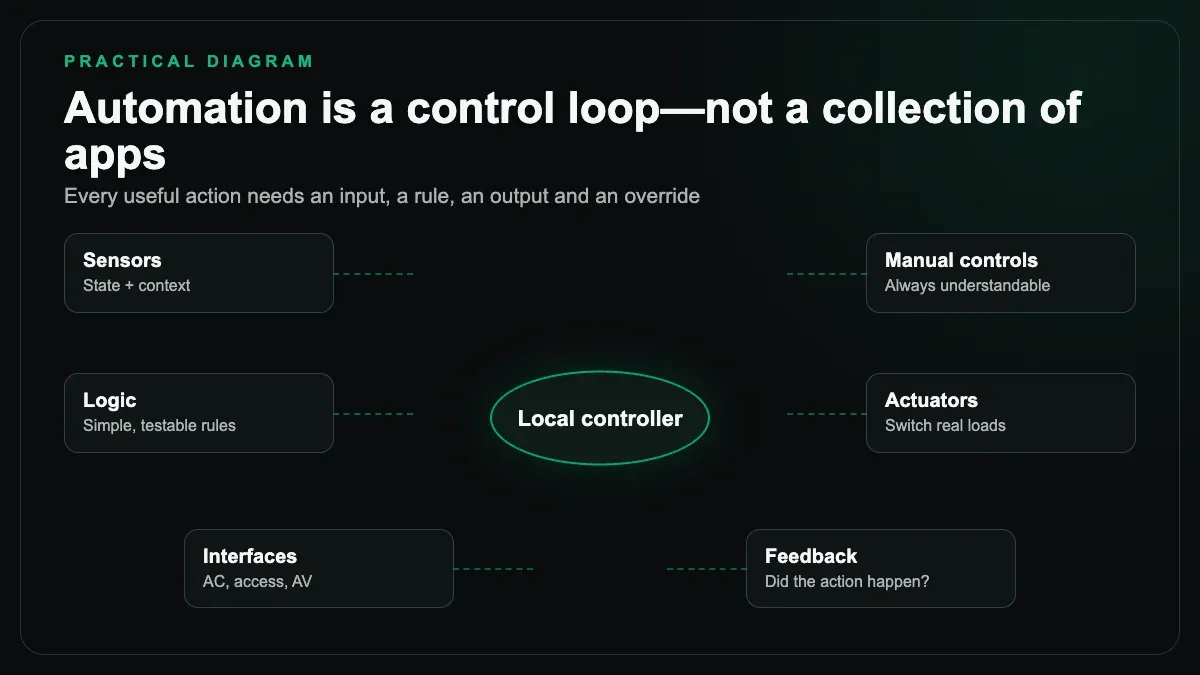
Each outcome needs four parts: an input, a rule, an output, and an override. Occupancy, door state, daylight, temperature, time, and a deliberate button press can all be inputs. The rule decides what those signals mean. The output changes a real load or sends a useful alert. The override lets a person take control without finding a phone.
A scene should also define its exceptions. An “all off” command may leave network equipment, refrigeration, medical devices, selected security equipment, and charging circuits alone. An occupancy routine needs a long enough timeout for someone reading or sleeping. A gate alert needs an image that helps identify a visitor, not another unexplained motion notification.
Indian homes add real design constraints
Power quality, backup power, heat, dust, monsoon humidity, reinforced concrete, stone finishes, and the way domestic staff use a home all affect the design. None of these requires a special marketing label. They require site-specific decisions.
- Power: decide which controller, network, access, and security components remain alive on backup power. Test restart behaviour after mains loss instead of assuming every device returns to the right state.
- Heat and access: keep controllers and gateways out of inaccessible hot ceiling voids. Panels need ventilation, labels, and room for service.
- Radio coverage: test the finished building. Reinforced floors, stone, metal switch boxes, mirrored surfaces, and equipment cabinets change wireless paths.
- Access: use individual, revocable credentials where staff or temporary visitors need entry. Preserve safe egress and a clear mechanical fallback.
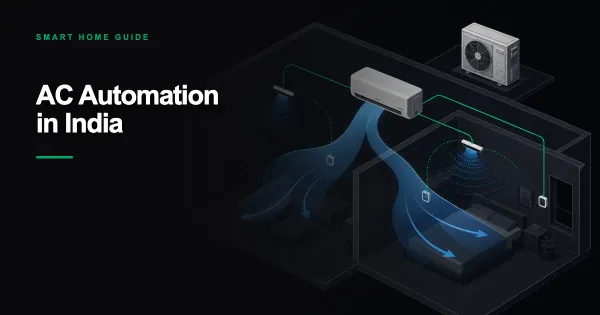
- Climate: integrate the exact AC model and control interface. Repeatedly cutting mains power to an inverter AC is not a substitute for proper control.
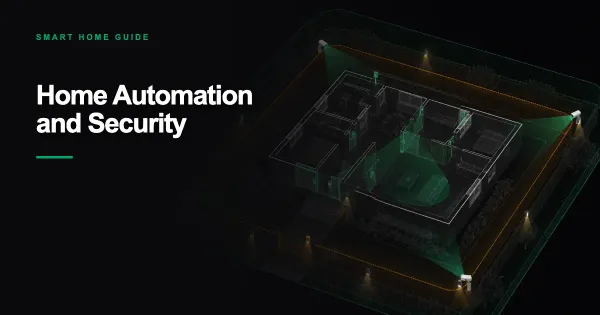
For the security-specific decisions, read home automation and security in India. For climate control, compare infrared and wired AC interfaces.
Choose the architecture from the building stage
New construction
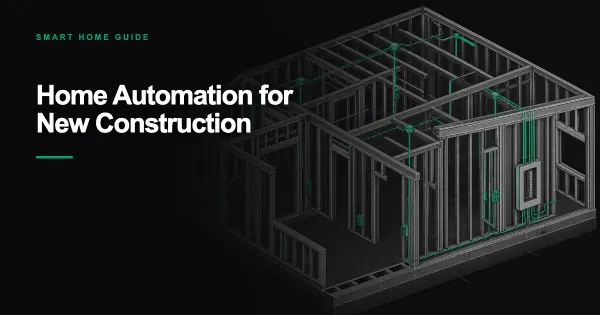
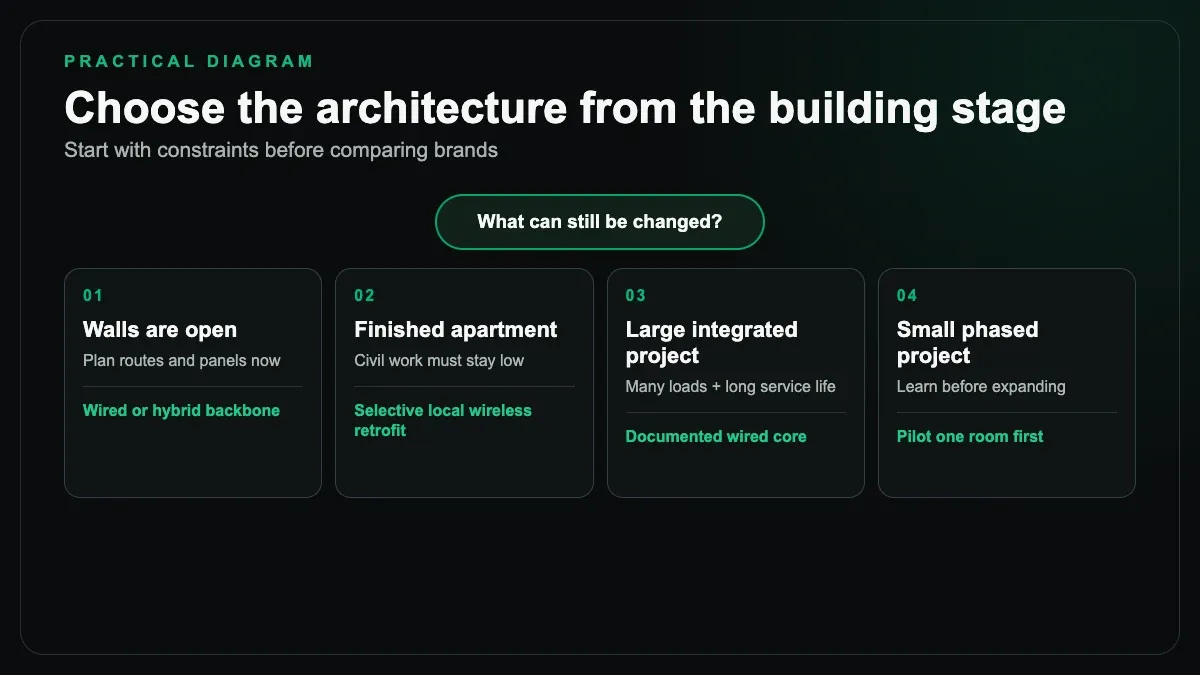
When walls and ceilings are open, plan conduits, deep back boxes, curtain power, sensor points, network access points, vertical risers, electrical-panel space, and accessible control gateways before finishes close. Core lighting and other long-life functions can justify a documented wired backbone. The detailed coordination sequence is in our new-construction automation guide.
Finished homes and retrofits
A retrofit starts with the existing switch boxes, neutrals, load types, network, wall materials, and tolerance for civil work. Local wireless control may be the right answer, but only after the actual building is surveyed. Start with one representative room and failure-test it before expanding. See the complete retrofit guide.
Wired, wireless, or hybrid
Wired control is valuable where long service life, many controlled circuits, predictable local operation, and deep integration justify the design effort. KNX is one established approach, but it still depends on correct topology, panel engineering, commissioning, and an owner receiving the project documentation.
Wireless control reduces disruption and can be excellent when the mesh or Wi-Fi network is deliberately built. Protocol logos do not decide cloud dependence, replacement availability, or device quality. Our Wi-Fi, Zigbee, and Z-Wave comparison explains those tradeoffs.
A hybrid system is not automatically better. It is useful when each subsystem has a clear reason to use its chosen transport and one documented controller presents the home coherently.
Automate the rooms with repeated friction
The best first room is the one where several small frustrations meet. A main bedroom can combine cooling, curtains, warm bedside lighting, and a clear all-off command. A living room may need AV sequencing, glare control, and a simple pause scene. An entrance may create the most value when identity, video, lighting, and revocable access must work together.
Do not rank rooms by size. Rank the repeated event, how many people share it, the consequence of failure, and whether normal physical control can remain obvious. Our guide to the best rooms to automate first provides a practical scoring method.
Budget follows scope and responsibility
A price per square foot hides the questions that actually change a quotation: the number and type of controlled loads, dimming requirements, curtain motors, AC interfaces, access hardware, network work, panel engineering, programming, testing, documentation, and post-handover service.
Two quotes are comparable only when their scope, exclusions, load ratings, commissioning work, owner training, configuration backups, and service terms align. The home automation cost guide for India shows how to compare them without relying on an invented universal price.
Describe failure behaviour in the brief
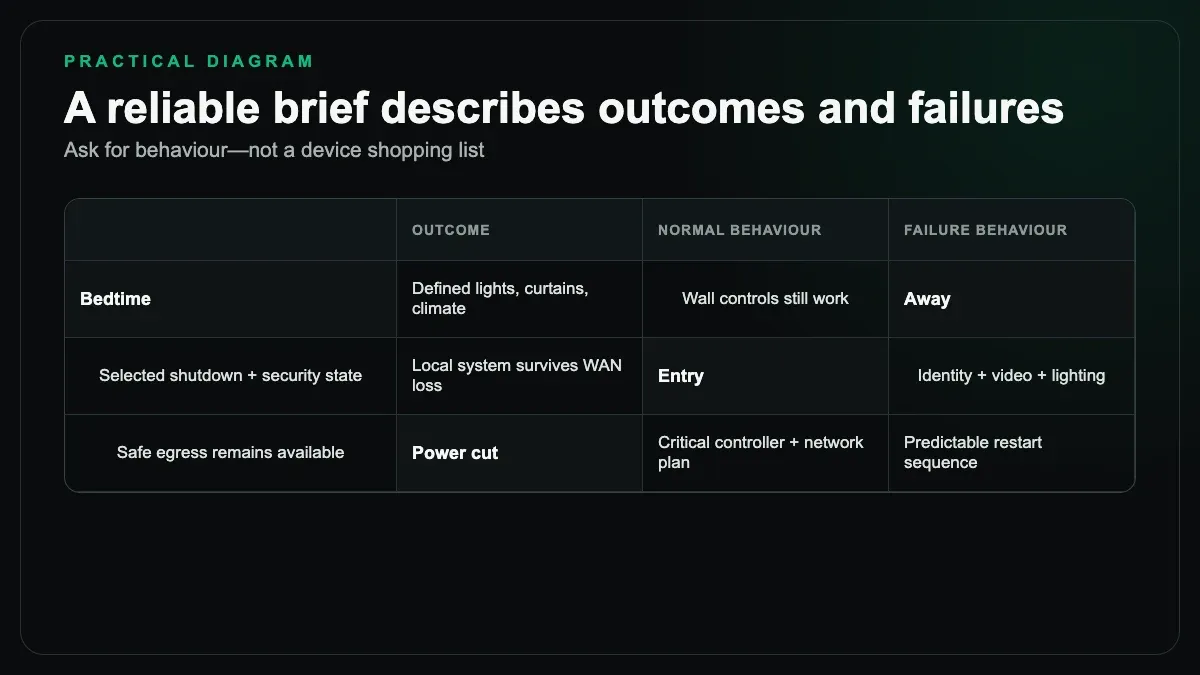
Ask the integrator to demonstrate the system with the internet disconnected while the local network remains on. Test physical switches, schedules, controller restart, AC state, selected alerts, and what happens when a device is unavailable. A dashboard showing green icons is not the same as a failure test.
What a good handover includes
- As-built drawings and labelled circuit schedules.
- A list of controllers, gateways, firmware, and model-specific interfaces.
- Administrator accounts owned by the client, with contractor access documented.
- A current configuration backup and a clear restoration process.
- Demonstrated manual operation and failure behaviour.
- A service path that does not depend on one unnamed technician remembering the site.
The goal is not a house that performs tricks. It is a home that quietly handles repeated work, reports the state that matters, and remains understandable to the people who live in and maintain it.
If you are planning a home in Jaipur or elsewhere in India, begin with the rooms, routines, construction stage, and failure expectations. The equipment list comes after that brief.