How are zones and priorities defined?
Plans mark listener areas and operational zones, then a matrix states which source can reach each one. Paging, scheduled messages and music receive explicit priorities and release behaviour.
Delhi NCR · Audio, Video and Entertainment
For a Delhi NCR PA and Background Music Systems project, the first useful conversation is about interfaces and responsibility, not hardware. The Greenfields Colony office asks what currently owns Public address, what the proposed system must exchange with Commercial audio, and who will operate PA systems after handover. Those answers expose dependencies, access restrictions and planned downtime before equipment enters the discussion. SmartR Spaces - Greenfields Colony confirms the exact address and survey logistics rather than treating the NCR label as a promise of availability.
The short answer
A PA system routes microphones, announcements and programme sources through processing and amplification to defined loudspeaker zones. Background music may share that path with lower priority. Design begins with listener areas, background noise, speech coverage, paging rules and any required emergency-system boundary.
For the full technical explanation, use our PA and Background Music Systems planning guide.
What the design has to settle
Plans mark listener areas and operational zones, then a matrix states which source can reach each one. Paging, scheduled messages and music receive explicit priorities and release behaviour.
Coverage, mounting height, background noise, room response and required level shape loudspeaker type and spacing. Amplifier loading follows the selected low-impedance or distributed-voltage architecture.
Useful direct sound, controlled reverberation, suitable microphone technique and enough level above background noise all matter. Turning up a reverberant system can make speech louder and less clear.
Music systems favour even, unobtrusive coverage and appropriate zoning. Source licensing and commercial music rights are an owner responsibility separate from system hardware.
Need more depth? The complete PA and Background Music Systems guide covers the wider technical context.
Technical relationships
These service-specific diagrams come from the canonical technical record; they do not depict a completed local project.


Decision aid
| Need | Design focus | Acceptance check |
|---|---|---|
| General announcements | Speech coverage and zone selection | Spoken-message walk test |
| Background music | Even level and source control | Zone transition and maximum-level check |
| Large or long room | Main and delayed coverage | Timing, polarity and consistency test |
Local planning
Branch facts are verified. Community observations, when present, are anecdotal and address-specific; they are not presented as citywide facts.
Evidence scope: The thread contains no calibrated readings and cannot establish how often the issue occurs or whether a specific venue caused it.
What this service can and cannot address: SmartR Spaces can measure a project site, design isolation and speaker coverage, and configure limits. It cannot control external noise sources, enforce the law or guarantee inaudibility beyond an untreated building envelope.
Evidence scope: Most replies were recommendations and personal impressions. The thread does not demonstrate AV, networking or access failures at any venue.
What this service can and cannot address: This source may support event-venue planning context only. SmartR Spaces must survey occupancy, room geometry, network demand and operating workflows before recommending systems; it must not imply that named venues need remediation.
Local planning questions
List the systems that own Public address, exchange data or commands with Commercial audio, and present controls for PA systems. Each interface needs a method, responsible party and test condition.
SmartR Spaces - Greenfields Colony checks the exact address, site contact, access permissions and workable visit window before committing a survey. The Delhi NCR label by itself is not a serviceability promise.
The client should identify the owner of the incumbent system and the person authorised to accept downtime, configuration changes and final test results. Unassigned third-party work is recorded as an exclusion or dependency.
Create individual rows for Public address, Announcements, Commercial audio, Background music, PA systems. Each row should name the incumbent owner, proposed connection, data or command direction, access authority, test witness and fallback when the interface cannot be completed.
Installation context
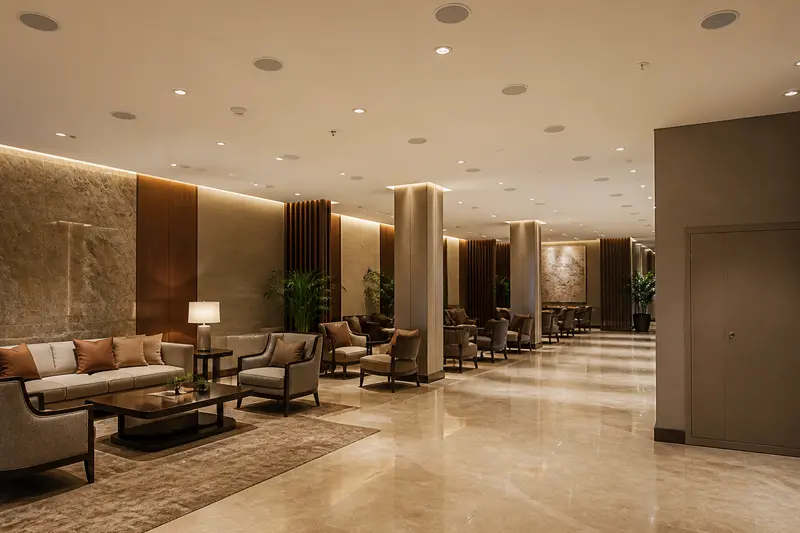
Representative photography supports planning; it is not presented as a completed SmartR Spaces project in Delhi NCR.


Verified branch
Confirm availability before visiting.
Continue planning