Best Rooms to Automate First (If You Have a Budget)
A room-by-room priority guide for Indian homes, with practical choices for comfort, security, wiring, and future expansion.
Best Rooms to Automate First When the Budget Has Limits
The sensible first question is not, "How do I make the whole house smart?" It is, "Which room irritates me every day?"
That answer produces a better system than a shopping list. A family in Jaipur may care far more about cooling a west-facing bedroom before bedtime than changing the colour of twelve decorative lights from a phone. Someone living with elderly parents may put the entrance first. A home with a projector, amplifier and several remotes may get more value from fixing the living room.
Automating one or two rooms well is a perfectly good start. In fact, it forces useful decisions. You discover whether the family actually uses scenes, whether voice control suits the household, and which manual controls must remain obvious. The broader principles are covered in our home automation guide for India. This article is about the harder part: choosing where the first rupee should go.
Start with daily friction, not room size
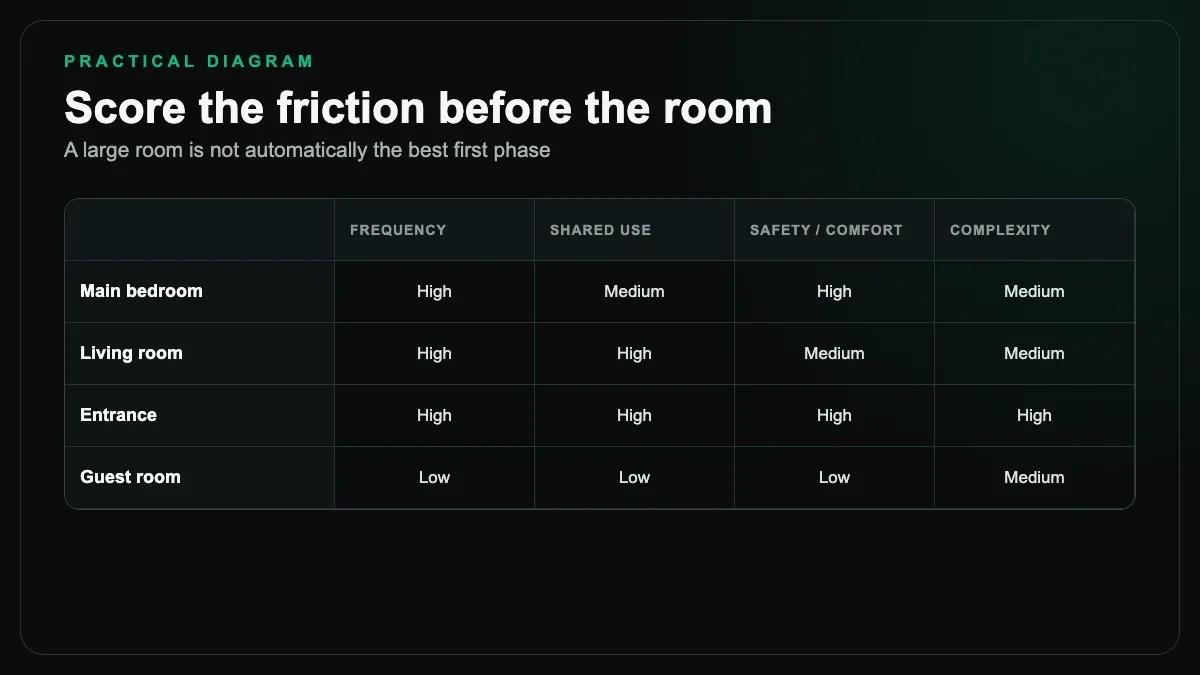
Walk through an ordinary weekday. Note every switch, remote, curtain and lock that someone repeatedly operates. Also note the moments when nobody operates them, although they should. The porch light stays on until noon. The bedroom AC starts only after the room has become hot. The television is off, but the set-top box and amplifier remain powered. A parent reaches across a dark room to find a small switch plate.
These are useful automation candidates because the problem already exists. A demo-room feature looking for a purpose is not.
Give each candidate a simple test. Does it happen most days? Does automation remove several actions or only replace one easy switch press? Will everyone in the home understand the result? Can it still work manually if the internet is down? That last question matters. A good home automation service should leave the home comfortable when an app is unavailable, not turn the family into technical support.
First choice for many homes: the main bedroom
Bedrooms produce strong returns because comfort depends on timing. Cooling, curtains, warm bedside lighting and an all-off command interact naturally.
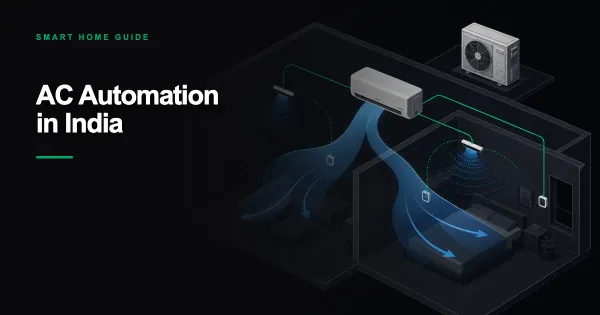
In Jaipur, a top-floor or west-facing bedroom can hold heat well after sunset. Pre-cooling before the usual bedtime can be more useful than blasting the AC after entering a hot room. The control method matters, though. An IR blaster may be appropriate for a split AC, while a wired interface can provide clearer feedback where the equipment supports it. Our detailed guide to AC automation in Indian homes explains that distinction.
A practical bedtime scene might close the blackout curtains, set low warm lighting, switch off dressing-table lights and prepare the AC. It should not kill every socket indiscriminately. Phone chargers, medical devices, air purifiers and a Wi-Fi access point may need continuous power. Label circuits before anyone writes a scene.
Morning automation should be restrained. Slowly opening a curtain can be pleasant, but Jaipur's early summer sun is not a gentle wake-up lamp. In a room that faces east, partial opening may make more sense than exposing the full window at once. During monsoon weeks, the family may want a different routine. Put these choices on a wall keypad or keep the normal switch behaviour familiar. Do not require someone half-awake to find a phone.
The main bedroom usually beats children's rooms as a first project. Children's schedules change, furniture moves, and automation that delights a ten-year-old may annoy a teenager. Wire those rooms for later, but learn the household's habits in the main bedroom first.
The living room wins when entertainment is the real problem
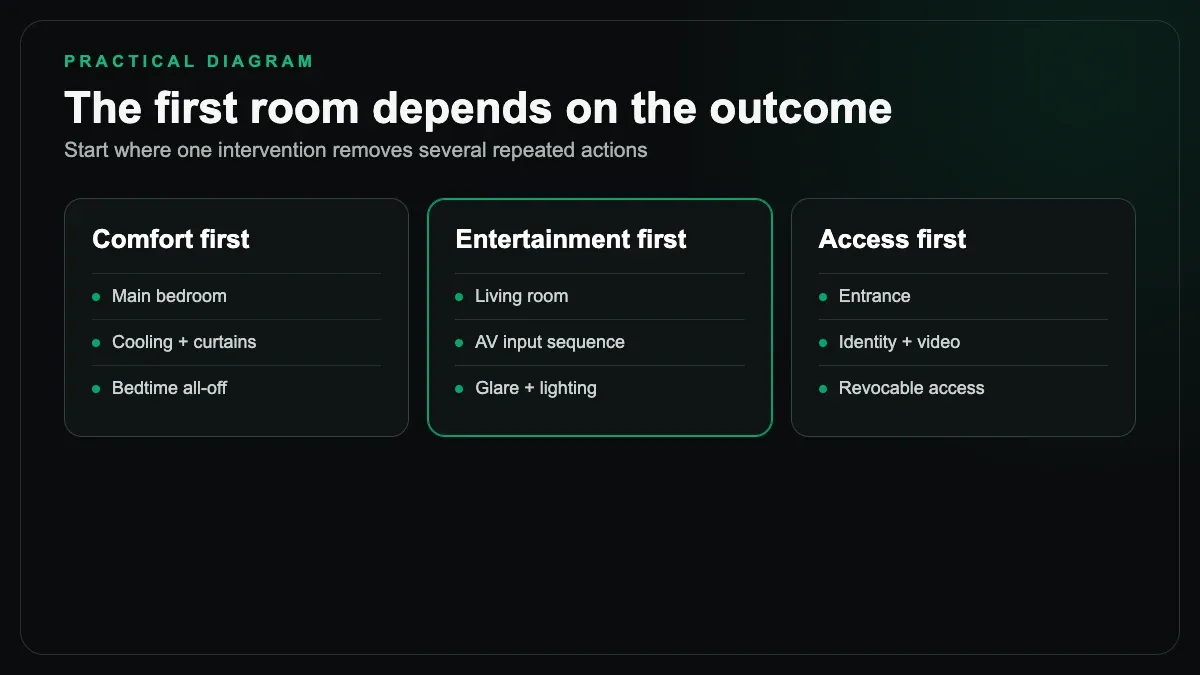
Choose the living room first if watching television currently requires a relay race between remotes. This is especially true when the room has a television or projector, set-top box, AV receiver, streaming device, motorised screen and several lighting circuits.
The worthwhile scene is not "turn one light blue." It is "watch a film": start the required equipment in the correct order, select the right inputs, lower the screen if there is one, close glare-facing curtains and dim only the relevant lights. Keep a clear pause or intermission scene too. Nobody wants to navigate an app just to raise enough light for tea.
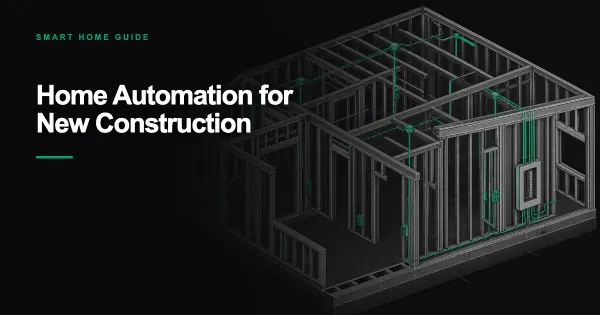
Rajasthani stone, thick masonry and decorative wall panelling deserve attention here. They can make casual placement of wireless equipment unreliable. A device that worked across the room before the stone cladding was installed may behave differently afterwards. If the house is under construction, plan cable routes and equipment ventilation before the carpenter closes the media unit. The same planning logic appears in our guide to home automation for new construction.
Do not hide every piece of AV equipment inside a sealed cabinet. Receivers and amplifiers need airflow. Infrared control also needs a deliberate emitter path when doors block line of sight. These are small details until the system starts missing commands.
Put the entrance first when access causes anxiety
The foyer and main door may be the best starting point for a family with frequent deliveries, household staff, children returning from school or elderly residents. Here automation supports a decision rather than adding spectacle.
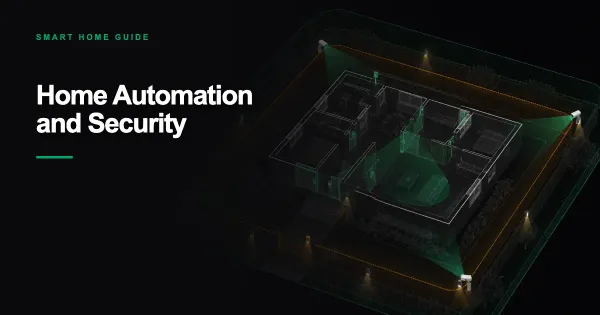
A useful entrance setup can show who is at the door, light the approach after dark and provide controlled access where the lock and door construction suit it. Staff access should be individual and revocable. One shared PIN taped inside a drawer defeats the purpose. Read what actually works for home security automation in India before treating a smart lock as a complete security system.
Door choice comes first. A beautiful lock fitted to a door that drags in humid weather will disappoint. So will an electronic strike installed without checking alignment, cable protection and a safe way to exit. For a large gate, the gate motor, pedestrian access and video call point may need separate decisions.
The entrance also benefits from plain automation. Turn on a defined set of lights when an authorised person arrives after dark. Do not illuminate the whole house. Do not open a door automatically merely because a phone appears nearby. Presence signals can be ambiguous, particularly in a home where the driveway or neighbouring floor sits close to the entry.
The kitchen deserves selective automation
Kitchens are tempting because they contain many appliances. Most should not be remotely switched.
Start with low-risk, repeatable jobs: scheduling a geyser on a suitable dedicated circuit, running task lighting, or keeping an exhaust fan on for a short period after cooking. A gas leak detector can provide an alert, but its selection, placement and maintenance should follow the manufacturer's instructions and the fuel type in use. It is not a decorative smart-home sensor.
Avoid putting heating appliances on generic smart plugs. Avoid scenes that can energise a kettle, toaster or cooktop while nobody is present. Appliance ratings, circuit protection and the local manual control all need review. Convenience never outranks electrical safety.
Kitchens also change during use. Steam, grease and monsoon humidity are rough on poorly selected sensors and touch panels. Keep controls away from splash and heat zones. If a motion sensor operates lights, make sure someone standing fairly still at the counter does not get plunged into darkness.
Rooms that can wait
Bathrooms and utility spaces are rarely the best first showcase. That does not mean they get no planning. Run suitable conduits and provide proper ventilation controls where required, but do not spend the opening budget on elaborate scenes in a space used briefly.
Guest rooms can also wait unless they are occupied often. A simple keycard-style energy routine may make sense in a hospitality setting, but a family guest room needs familiar switches more than theatre. Home offices vary. If video calls, glare, AC and door notifications create daily friction, the office can jump ahead of the living room. The priority follows actual use.
Spend early money on infrastructure
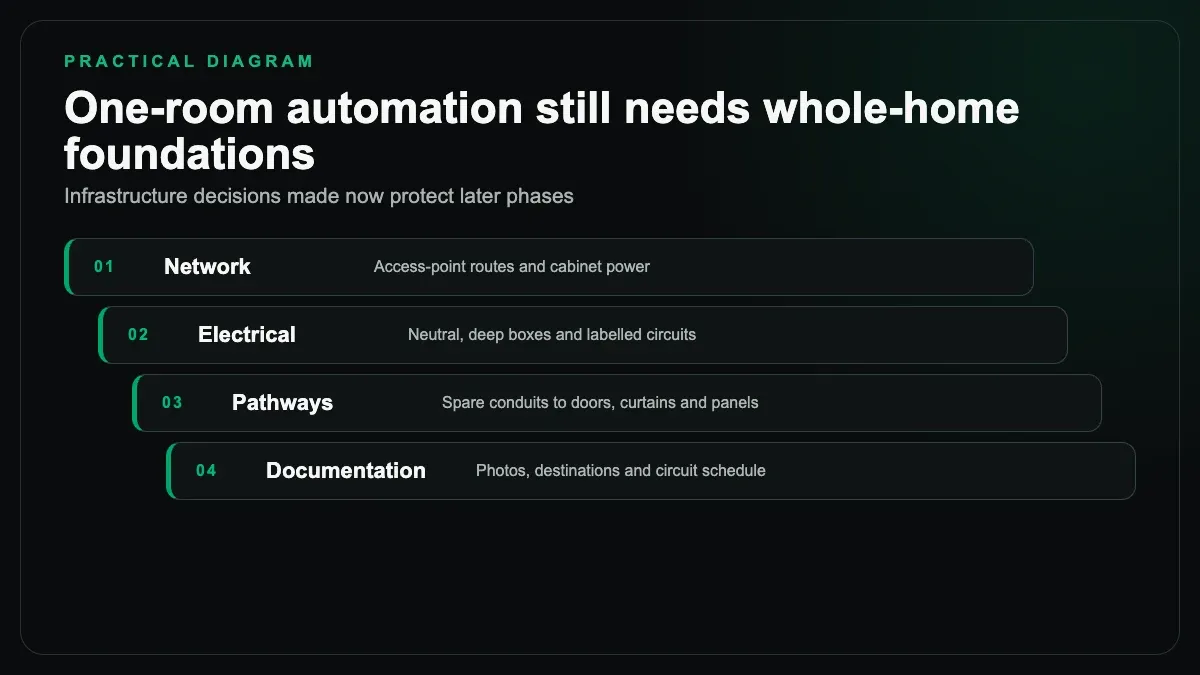
Even when only one room is being automated, plan the routes for the rest of the home. This is the unglamorous decision people appreciate later.
Provide accessible conduits between floors, the electrical panel, key switch locations, curtain pockets, television walls, ceiling sensor points, entrance equipment and the network cabinet. Separate power and data routes where appropriate. Bring neutrals to switch boxes if the proposed devices require them. Give deep boxes enough room for terminations rather than forcing modules behind a crowded plate.
Plan the network as infrastructure too. One router hidden beside the incoming internet line is not a whole-home design. Access points need power or data routes and sensible placement. Thick stone and reinforced concrete do not care what the router packaging promises.
Most importantly, leave drawings. A photograph of an open wall with a rough arrow is not a cable schedule. Record conduit origins, destinations, panel labels and any spare routes before plaster covers them.
A sensible order for a typical phased project
For a couple or family focused mainly on comfort, begin with the main bedroom, then fix the living room, then address the entrance. Add the kitchen selectively. For a household focused on access and staff movement, reverse the first and third choices. For someone building now, infrastructure comes before every room-level feature.
There is no moral prize for automating every circuit. Some switches are already fast, clear and reliable. Keep them.
The best first room is the one where several small frustrations meet, and where one well-designed scene can quietly remove them. Start there. Live with it through hot days, visitors, an internet outage and a change in routine. What you learn will make the next room much better.