AC Automation in India: IR Blasters vs Wired Control
A practical comparison of IR and wired AC control for Indian homes, including inverter behaviour, feedback, zoning, and installation choices.
AC Automation in India: IR Blasters vs Wired Control
Air-conditioning control is where smart-home promises meet a stubborn piece of reality: the AC already has its own electronics, its own remote and its own ideas about what state it is in.
Lighting is comparatively straightforward. A relay is either on or off. An inverter split AC has modes, setpoints, fan speeds, swing positions, compressor logic and sometimes a brand app. Send the wrong command or lose track of the current state, and the controller may display "24°C, cool" while the indoor unit is doing something else.
That does not make AC automation a bad idea. It makes interface choice important. This article goes deeper than the AC section in our home automation guide for India and explains when a small infrared blaster is enough, when wired control earns its place, and which so-called energy-saving routines should be treated with suspicion.
First decide what outcome you want
"Control the AC from my phone" is a weak brief. The manufacturer's remote already controls it from across the room, and many newer units have their own app. A useful brief sounds more like this:
The bedroom should be comfortable before sleep. The guest-room AC should not run all day after someone leaves. The living-room cooling should coordinate with occupied hours without cycling the equipment carelessly. A central keypad should shut down nonessential cooling when the family leaves, while preserving any room that must remain conditioned.
Different outcomes need different levels of integration. Remote replacement can use infrared. Reliable central state, scheduling and coordination may justify a wired gateway. Large multi-split or ducted systems need an HVAC-led discussion before the automation contractor promises anything.
How infrared control works
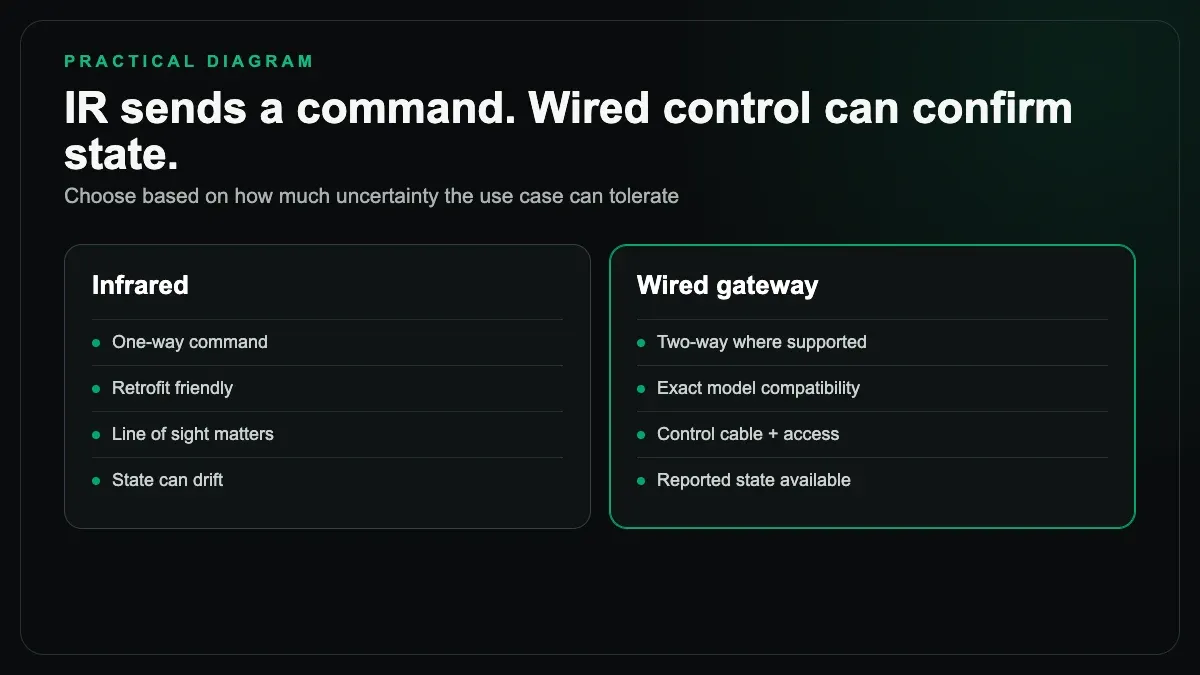
Most split AC remotes transmit a packet of infrared data. Unlike a simple television remote that may send "volume up," an AC remote commonly sends a fuller state: cooling mode, temperature, fan selection and other settings. An IR blaster learns or uses the relevant code set, then emits a similar signal toward the indoor unit.
This route is attractive in a finished Jaipur apartment because it needs little disruption. The blaster requires power and a clear or reflected IR path. It can sit near the indoor unit, join an automation network and reproduce common remote commands. For a single room, that may be entirely adequate.
But infrared is one-way. The blaster sends. The AC does not necessarily confirm.
If somebody uses the original remote, the automation controller may not know. If the signal misses because the emitter moved, a curtain blocks the path, or the unit's receiver has an awkward angle, the software can still assume success. Power cuts add another wrinkle because models differ in how they recover when electricity returns. Some remember the last state. Some do not. Voltage fluctuation and generator changeover can expose that behaviour at inconvenient times.
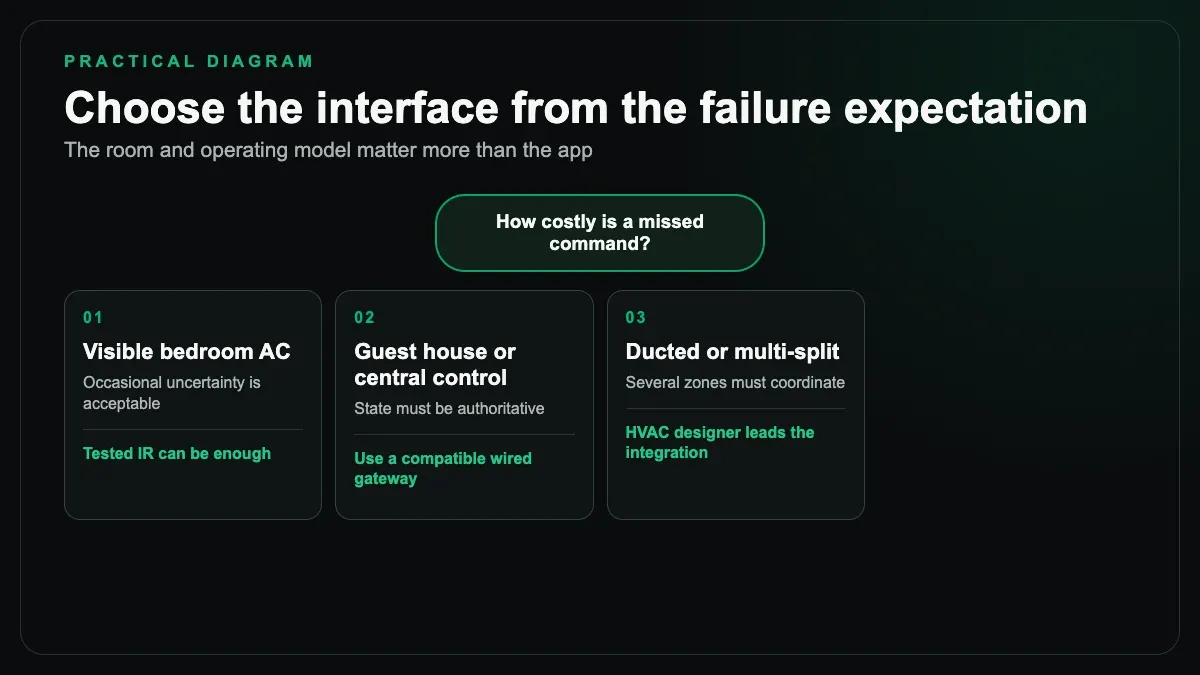
Do not solve this by throwing away the original remote. Manual control remains useful. Instead, decide whether occasional state uncertainty is acceptable. In a bedroom where the user can see and hear the unit, it often is. In a guest house where management expects a central dashboard to be authoritative, it may not be.
IR placement is an installation job, not an app setting
An IR device stuck wherever a socket happens to exist is not a finished installation. Test commands with curtains open and closed, from the actual mounting point, across several indoor-unit functions. Keep the emitter's cable neat and serviceable. If an adhesive emitter is used, account for surface heat and cleaning.
False confidence is the common failure. The installer tests power once, sees the beep, and leaves. The family later discovers that mode changes work but swing control does not, or that the unit misses commands in bright direct sun. Build and test the exact scenes the household will use.
The code set also needs care. Closely related AC models may respond differently. Learn commands from the supplied remote where the controller supports it, and retain a record of the model. A future indoor-unit replacement may require reprogramming.
What wired control changes
A wired interface can provide two-way communication, depending on the AC equipment and gateway. The controller may read whether the unit is on, its setpoint, operating mode, fault information or other supported values. It can issue a command and then see the reported state.
The phrase "wired AC control" covers several things. A brand may offer a dedicated dry-contact input, a proprietary gateway, a central-control bus or an interface to a building protocol such as Modbus or BACnet. Availability varies by model and market. A gateway name on a brochure is not enough. Ask for compatibility with the exact indoor and outdoor unit references proposed for the project.
This is particularly important during new construction. The best time to route a control cable between the AC equipment, electrical or automation panel and network location is before ceilings close. Our guide to automation decisions before the walls close covers the broader coordination work. Leave access to gateways and junction points. A device buried above a fixed ceiling without an access panel will eventually demand a messy repair.
Wired control costs more in design effort, cable and compatible interfaces. It earns that cost when confirmed state matters, when several units must coordinate, or when the project has a central building-management requirement. It is not automatically superior for one ordinary split AC in a completed bedroom.
Inverter ACs dislike crude on-off thinking
An inverter AC varies compressor output to maintain conditions rather than behaving like a basic fixed-speed appliance. Repeatedly cutting mains power with a relay is not intelligent control. It can bypass the unit's normal shutdown behaviour and creates a poor user experience. The AC should generally receive commands through an interface designed for it.
Scheduling can still be useful. The goal is not to hammer the unit on and off every few minutes. It is to align operation with occupancy and comfort. Start cooling before a predictable occupied period when that makes sense, relax the setpoint when the room is temporarily unused, and shut the unit down after a meaningful vacancy rather than reacting to every brief sensor gap.
Presence sensing needs context. A person sleeping is almost motionless. A basic motion sensor may decide the room is empty and switch off the AC at 2 a.m. That is bad automation. Bedroom logic may use a bedtime scene, door state, manual override, longer timeouts or other signals instead of relying on motion alone.
Likewise, a living room can appear vacant while someone watches a film. Sensor placement and timeouts matter more than a clever dashboard.
Pre-cooling can improve comfort, but do not invent savings
Pre-cooling is easy to sell as an energy-saving feature. Its dependable benefit is comfort. Whether it reduces consumption depends on building heat gain, setpoints, AC efficiency, duration, occupancy and user behaviour. Without measuring a specific home, promising a percentage is fiction.
Jaipur creates a clear design challenge. A west-facing room with a large window and heavy stone surfaces can remain hot into the evening. Closing external shading or curtains before peak sun, where the building allows it, may reduce the cooling burden. Starting the AC at a sensible setpoint before occupancy may prevent the occupant from selecting an extreme temperature in frustration. Those strategies can be tested. They should not be sold as guaranteed bills.
Measure if energy is the objective. Use appropriate metering at the distribution board or supported equipment data, establish a baseline across comparable weather and occupancy, then adjust the routine. Even then, interpret results carefully. A monsoon week and a dry May week are not comparable.
Multi-split and ducted systems need HVAC coordination
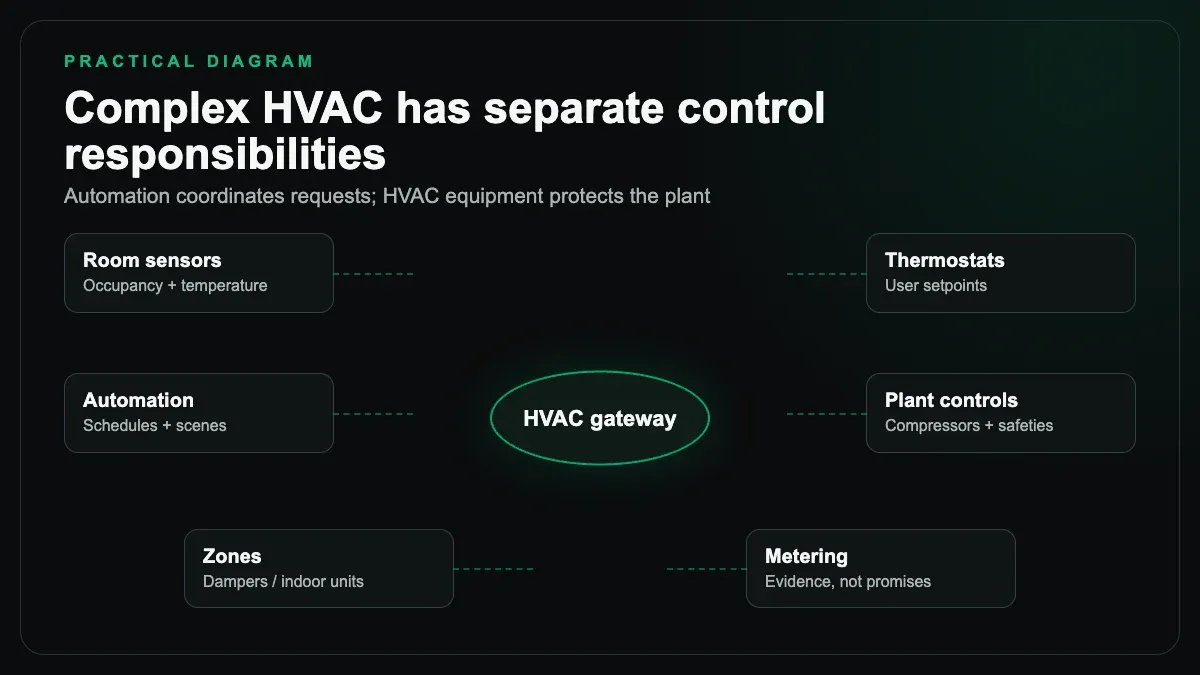
One outdoor unit serving multiple indoor units introduces operating constraints that the automation system must respect. Some systems limit simultaneous modes. Capacity is shared. A central controller may expose only certain commands. Do not let the smart-home interface pretend each room is an independent appliance if the refrigeration system says otherwise.
Ducted homes add thermostats, dampers, return-air design and sometimes multiple zones. Closing too many dampers can create airflow problems. This is HVAC engineering territory. Automation can schedule and present controls, but it should not rewrite airflow logic without the equipment designer.
Ask the HVAC vendor for control documentation early. Ask who supplies the gateway, who commissions it and who owns fault diagnosis when the central app and the AC controller disagree. Put those responsibilities in writing before handover.
Integrate the controls people actually use
An AC scene should live in more than a phone. Provide wall control where it is expected. A bedside button for "sleep" or an entrance button for "away" is quicker and clearer than opening an app. The original AC remote can remain available, with the state-sync limitation understood if the system uses IR.
Voice commands are optional. They can be helpful when hands are occupied, but names such as "left bedroom AC" quickly become awkward. Good room naming and limited, memorable commands beat a long catalogue.
Connect AC automation to the wider room plan. If you are choosing where to begin, see our guide to the best rooms to automate first. If the project also includes curtains, do not assume closing them at every cooling command is desirable. A person may want daylight. Give them a separate choice or make the combined scene explicit.
For retrofit work, assess power, access, network coverage and wall finish before promising an invisible installation. Rajasthani stone cladding and packed false ceilings can turn a tiny control device into a difficult cable route. A proper home automation service should inspect those conditions before fixing the interface choice.
The honest choice
Use IR when the home is finished, the AC is a conventional split unit, minor state uncertainty is acceptable, and the user mainly wants scenes or remote commands. Install it properly and test every required function.
Choose a supported wired interface when feedback matters, several units need dependable coordination, the system serves guests or staff, or new construction makes the cabling straightforward. Verify exact model compatibility first.
And leave mains-switching shortcuts alone. AC automation should work with the equipment's control logic. It should make hot rooms more predictable and forgotten units less common. That is useful enough without attaching an imaginary savings figure to it.