Home Automation Cost in India: How to Read a Real Quote
Home automation cost in India explained through circuits, wiring, controls, commissioning, and support, with practical budgeting advice for Jaipur homes.
Home Automation Cost in India: How to Read a Real Quote
People ask for a home automation price per square foot because builders have trained everyone to think that way. Flooring has a rate. Paint has a rate. Automation looks like another line item.
It is not.
A 3,000-square-foot home with conventional lighting, six split ACs, and a few curtains can have a simpler control system than a 1,600-square-foot apartment with dimmable lights, scene keypads, motorised blinds, a video door station, energy monitoring, and multi-room audio. Floor area provides context. The number of controlled circuits, the type of loads, the installation stage, and the expected behaviour determine the work.
That is why one-line price promises are usually misleading. A useful quote should show what is being controlled, how it will work when the internet fails, and who supports it after handover.
For a broader view of what belongs in the system, read our home automation guide for India.
Start by counting circuits, not rooms
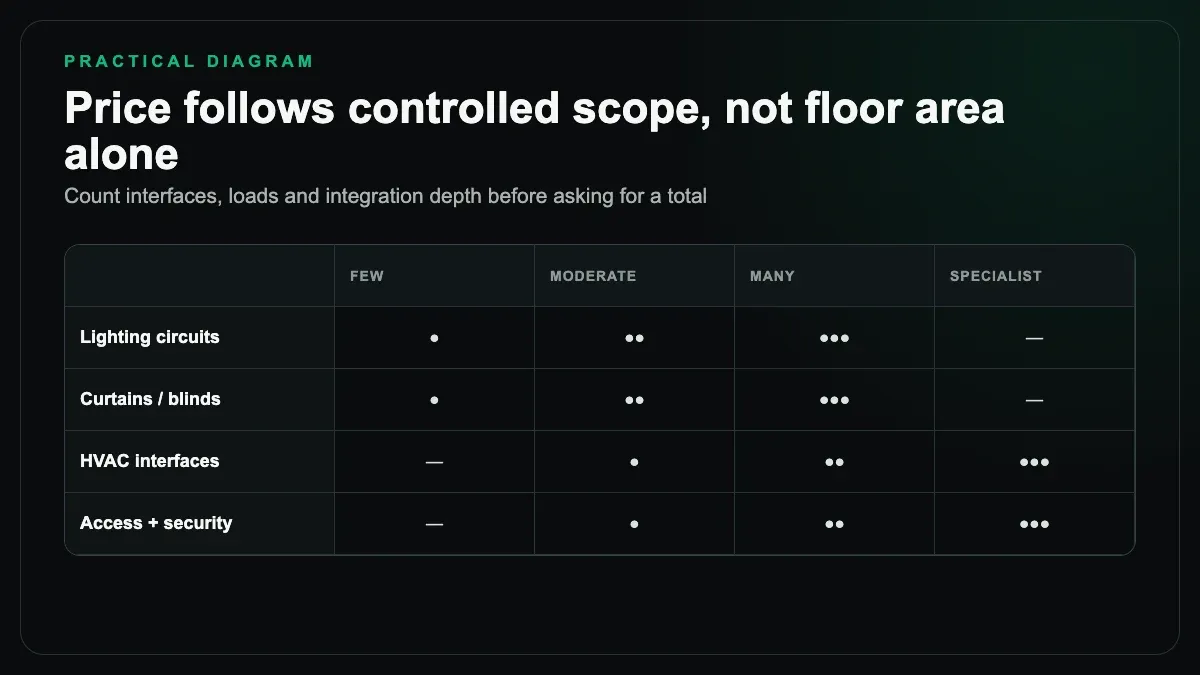
An automation contractor needs a circuit schedule. "Automate the living room" is not a scope.
The living room may contain eight lighting circuits, two fans, a curtain motor, a split AC, television equipment, and a balcony light. Each load has an electrical requirement and a control requirement. Some lights only need on-off switching. Others need phase dimming, 0-10V control, DALI, or a driver specified by the lighting designer. Fans need speed control. ACs may use infrared or a wired gateway. Curtains need direction control and limit handling.
Count these separately:
- On-off lighting circuits
- Dimmable lighting circuits and their driver types
- Fan circuits
- Heavy loads such as geysers and pumps
- AC indoor units and their interfaces
- Curtain or blind motors
- Door locks and access points
- Motion, door, leak, gas, temperature, and air-quality sensors
- AV zones and network points
- Keypads, touch panels, and app users
The count is not busywork. It lets two quotations be compared on the same basis.
A cheap quote may control ten grouped circuits where another controls twenty individual circuits. Both can say "full lighting automation" on the cover page.
Retrofit and new construction spend money differently
A retrofit often uses relay or dimmer modules behind existing switches. It can avoid broad civil work, but the survey and installation have to deal with the wiring that is already there. Shallow boxes, missing neutrals, mixed circuits, and weak Wi-Fi coverage add labour or limit product choices.
A new build can place actuators in a central panel and run control cable before plaster. That creates more design work early, and wired equipment can cost more upfront, but the electrical layout is deliberate and maintenance can be cleaner.
Neither route is automatically cheaper in every project.
A small retrofit with standard lights may be economical. A large retrofit that needs switch boxes replaced, the network rebuilt, and special interfaces for every AC can climb quickly. A wired new build with disciplined circuit planning may avoid a pile of individual wireless devices. The correct comparison uses the same functions and the same handover standard.
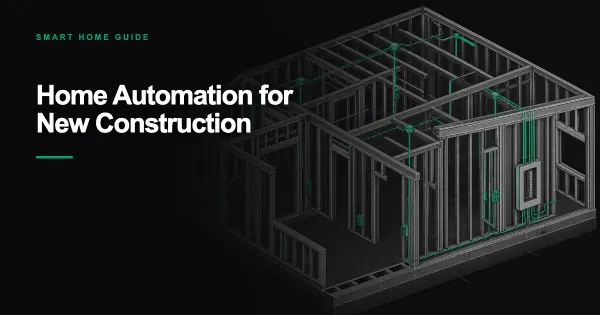
If the home is already occupied, our retrofit home automation guide covers the physical checks that affect the quote. If walls are still open, use the new-construction automation checklist before the electrician closes them.
Where the budget actually goes
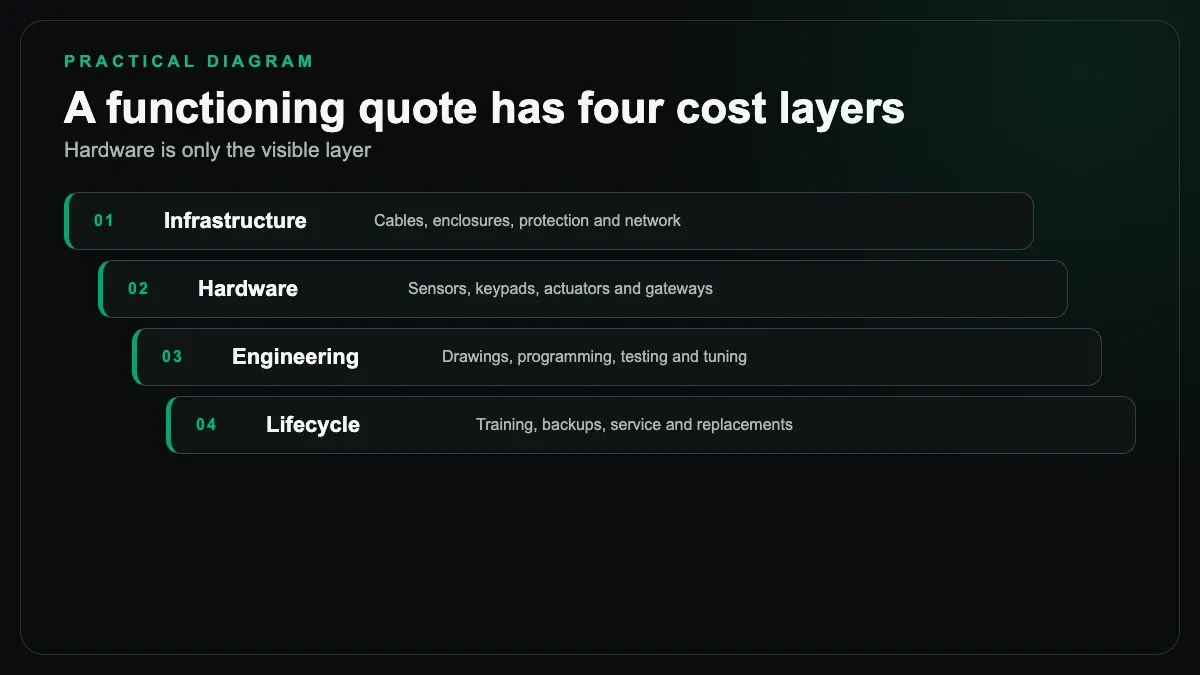
Hardware is only one part of a professional system.
Control hardware
This includes relays, dimmers, actuators, gateways, hubs, sensors, power supplies, and interfaces. Product prices vary widely by brand, protocol, channel count, load rating, and certification.
A relay is not interchangeable with a dimmer. A dimmer that works with one LED driver may flicker with another. An AC infrared controller does not offer the same feedback as a wired interface. Quote comparisons must keep those differences visible.
User controls
Physical switches and keypads can consume a surprising share of the budget. A standard modular switch retained in a retrofit is different from a metal-finish scene keypad or a wall touch panel. The latter may be worthwhile in important rooms, but installing premium panels everywhere is rarely the best first use of money.
Apps and voice assistants are additional interfaces. They should not replace physical control for everyday lighting.
Electrical and network work
Automation depends on the boring infrastructure. The quote may need to include deeper switch boxes, neutral wiring corrections, distribution-board changes, contactors for heavy loads, a network rack, access points, surge protection, or backup power for the controller.
Jaipur homes add familiar complications. Thick stone can weaken wireless links. A router placed at one end of a villa cannot reliably serve outdoor cameras and a room two floors away. Summer heat makes an unventilated cabinet a poor home for network and control equipment. Fixing those conditions is part of the system, not an optional IT upsell.
Engineering and programming
Someone has to turn a list of devices into behaviour.
That work includes naming, grouping, scenes, schedules, sensor logic, permissions, testing, and failure recovery. "Good Night" is not a product. It is a programmed sequence that may switch selected lights, check doors, change AC setpoints, close curtains, and leave a safe path light active.
The sequence needs discussion. In a joint family, one person's ideal automatic shutdown may annoy everyone else. Staff access times, guest behaviour, elderly users, and children's rooms change the logic. Engineering time pays for those conversations and revisions.
Commissioning and handover
Installation is not complete when a device appears online.
Commissioning tests every circuit, physical control, scene, sensor, network route, and restart condition. The team should verify behaviour without internet and after a power cut. Admin ownership should be transferred. Configuration backups, circuit schedules, warranty records, and basic troubleshooting instructions should be handed over.
This work is easy to omit from a price sheet. It is expensive to discover later that nobody has the controller password.
Support
Ask what happens in month thirteen.
Products receive firmware updates. Routers are replaced. A family changes its routine. An interior contractor disconnects a sensor while repainting. Support may be included for a period, sold as an annual plan, or charged per visit. Any model can be reasonable if it is written clearly.
Our home automation service page describes the design-to-handover scope we use for projects in Jaipur and other served cities.
How to build a budget without a fake package
Divide the project into priorities.
Core infrastructure comes first. This means the network, controller, electrical protection, and any cable that becomes difficult to add later.
Daily controls come next. Automate the lights, fans, ACs, curtains, and access points that the family touches repeatedly. Do not spread the budget thinly across every possible device.
Sensors and scenes make the controls behave intelligently. Occupancy, door state, temperature, and time can remove repetitive actions. Start with logic the household can explain in one sentence.
Premium interfaces follow where they add value. A scene keypad at the entrance or bedside can be excellent. Ten wall tablets may be a maintenance burden.
Expansion should remain possible. Leave panel capacity, conduits, network ports, and software licences understood. A staged system is sensible only if phase two does not require replacing phase one.
This priority order produces a better project than choosing a "silver", "gold", or "platinum" package by bedroom count.
How to compare two home automation quotations
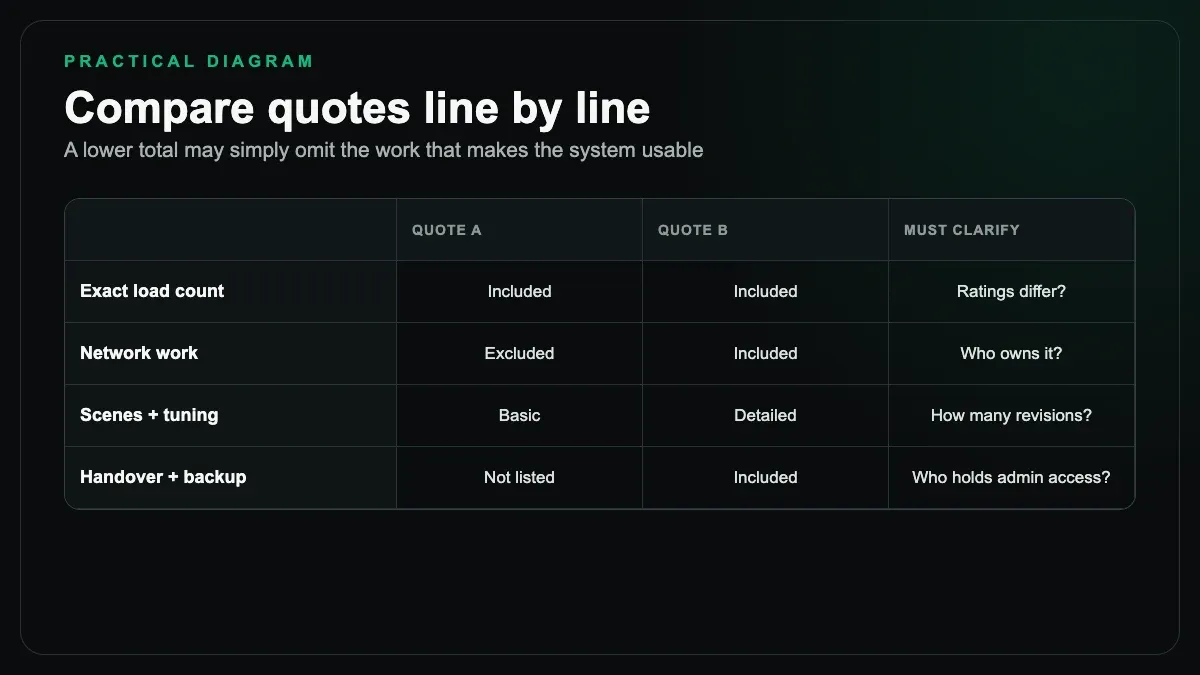
Put both quotes beside the electrical drawings and ask for a line-by-line reconciliation.
Check whether they include the same number of circuits. Check dimming separately from switching. Check the exact AC integration method. Check whether curtain motors are included or only their control. Check camera storage, lock hardware, network equipment, taxes, installation, programming, and support.
Then ask about dependencies:
- Which functions need internet?
- Which functions need the vendor's cloud?
- Can another trained integrator service the system?
- Who owns the administrator account and project file?
- Are software licences recurring?
- What is excluded from electrical work?
- What happens when a device is discontinued?
- How are changes after handover priced?
A more expensive quote may include infrastructure and commissioning that the cheaper one leaves as assumptions. It may also simply be expensive. The detail lets you tell the difference.
Claims about savings deserve suspicion
Automation can reduce waste. Occupancy logic can switch off forgotten loads. Schedules can prevent geysers and outdoor lighting from running unnecessarily. Better AC control can avoid cooling empty rooms. Energy monitoring can identify a load that is behaving abnormally.
But a universal savings percentage is not credible.
The result depends on the home's starting habits, equipment, climate, tariff, occupancy, and control strategy. An efficient household that already switches everything off has less waste to remove. A large home with staff, variable occupancy, and several ACs may have more opportunity.
Ask the proposer to explain each expected saving in terms of a specific load and a specific control action. "AI optimisation" is not a calculation.
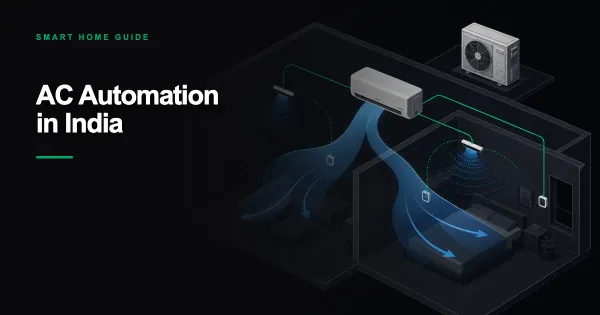
AC is usually the most important load in an Indian home, so our guide to AC automation in India is a useful next read before accepting a payback claim.
What should be fixed before the site survey ends
A good first meeting does not need a final rupee figure. It should produce enough facts for a defensible scope.
Record the rooms, circuits, load types, installation stage, preferred physical controls, major scenes, security boundaries, internet-failure expectation, network condition, and future phases. Photograph the distribution board and representative switch boxes with the owner's permission. Confirm who coordinates with the architect, electrician, HVAC contractor, lighting consultant, and interior team.
The quotation can then show alternatives. Perhaps the core lighting stays wired while secondary sensors use Zigbee. Perhaps the existing switches remain in bedrooms while the living room gets scene keypads. Perhaps cameras remain a separate professional system but important events appear in the home interface.
Those are useful choices. A single total with no architecture is not.
The honest answer to "what will it cost?"
It will cost the sum of controlled circuits, suitable hardware, safe electrical work, reliable networking, engineering time, commissioning, and support. The total becomes clear only after those parts are counted.
That answer is less satisfying than a price per square foot. It is also the answer that prevents a homeowner from comparing an app-controlled switch package with a properly commissioned automation system and wondering, six months later, why the cheaper number bought a completely different thing.
Get the scope right first. Then negotiate the number.