KNX Wired Home Automation Explained for Indian Homes
KNX wired home automation explained for Indian homes: bus wiring, panels, commissioning, costs, serviceability, and when wireless is the better choice.
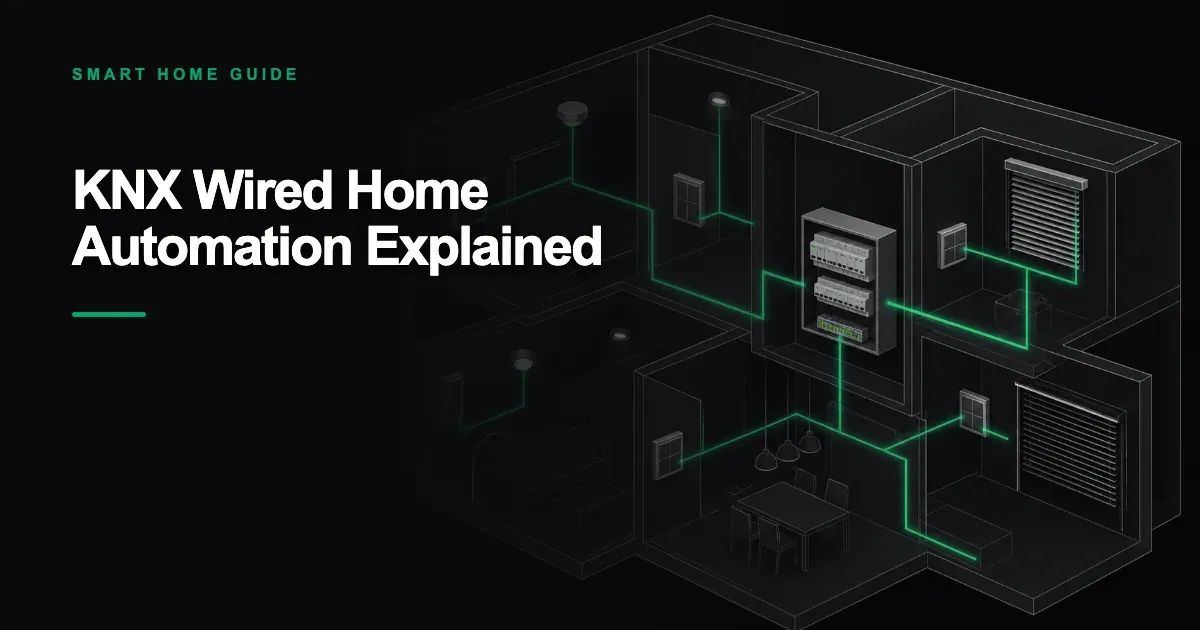
KNX Wired Home Automation Explained for Indian Homes
KNX is often presented as the answer to every serious home automation project. It is wired, established, supported by many manufacturers, and used far beyond houses. Those are real strengths.
They do not make KNX the right answer for every house.
A well-designed KNX system can run core lighting, blinds, climate control, sensors, and scenes locally for years without asking a cloud server for permission. A badly planned KNX project can leave the owner with an undocumented panel, expensive changes, and one programmer who alone understands the file. The standard is solid. The project still depends on human work.
This guide explains what is inside a KNX installation, what must happen before plaster, and how to judge whether the extra planning is worth it for an Indian home.
For the broader system picture, begin with our home automation guide for India.
What KNX actually is
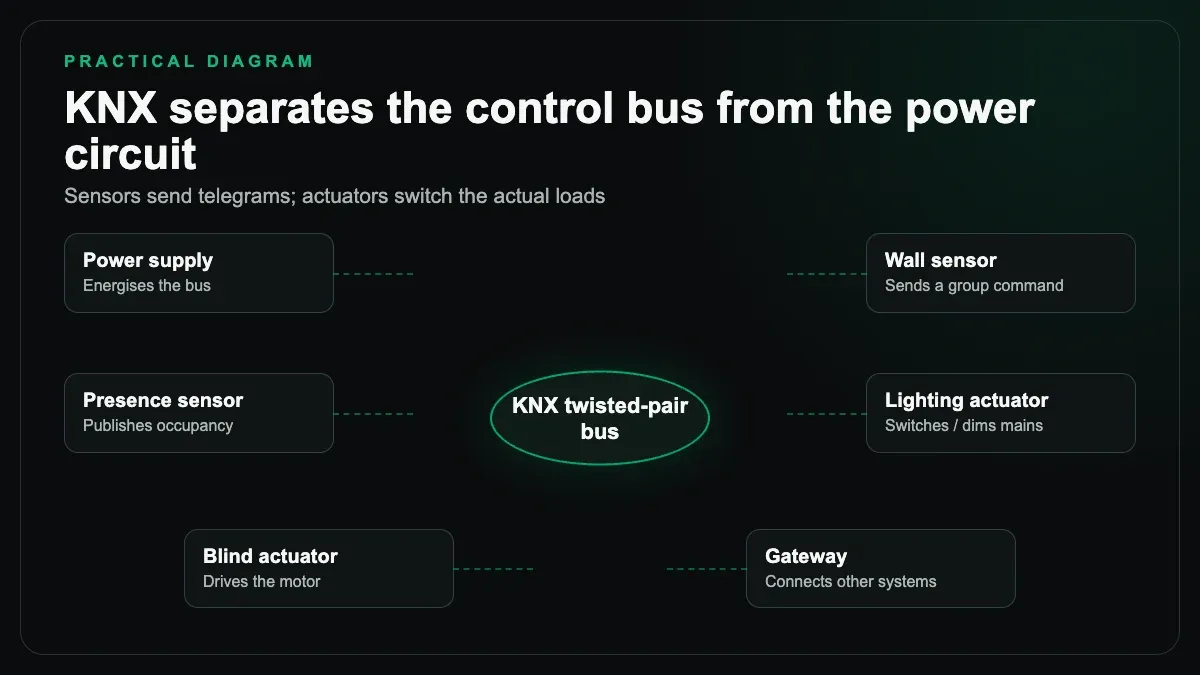
KNX is an open building-control standard. Products from different participating manufacturers can communicate over a common system when they are selected and commissioned correctly.
In a common KNX twisted-pair installation, a dedicated bus cable carries control messages between sensors and actuators. The bus is separate from the mains wiring that supplies the loads. A wall keypad can send a command over the bus, and an actuator in an electrical panel switches or dims the appropriate circuit.
The keypad does not have to carry the lighting load. That is an important difference from a conventional switchboard.
A simple lighting action looks like this:
- Someone presses a keypad button.
- The keypad sends a telegram to a group address.
- The assigned actuator receives it.
- The actuator changes the circuit state.
- Other devices can receive the same information and update their indicators or logic.
This happens locally. Remote apps and voice assistants can be added through gateways, but the basic control does not require them.
KNX can also run over other media, but twisted-pair wiring is the version most homeowners encounter in a new-build discussion.
Sensors, actuators, and the electrical panel
KNX becomes easier to understand once the devices are separated by role.
Sensors create commands or measurements. A wall keypad is a sensor in KNX language. So are motion detectors, temperature sensors, weather stations, and contact inputs.
Actuators perform electrical work. Relay actuators switch lights and other loads. Dimming actuators control compatible lighting. Blind actuators drive motors in two directions. HVAC interfaces pass commands to climate equipment.
System devices keep the bus operating. They include power supplies, line couplers, IP interfaces, and other infrastructure.
Many residential KNX designs place actuators in central or floor-level panels. Lighting circuits return to those panels instead of being switched locally at each room. This produces orderly service access when the panels are sized, labelled, ventilated, and documented. It also requires coordination with the electrical consultant before wiring begins.
A panel drawn after the electrician has already pulled conventional loops is not a design. It is a rescue job.
Why new construction is the natural moment
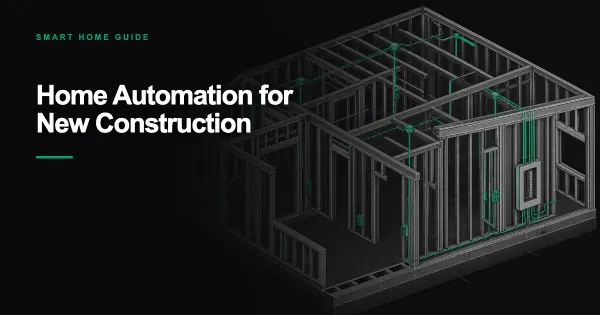
KNX bus cable and the chosen load topology need to be planned while walls and ceilings are open. Keypad points, sensors, curtain motors, distribution panels, network equipment, HVAC gateways, and future conduits all compete for space in the construction schedule.
The structural stage is when the team should decide:
- Where control panels will sit
- Which circuits return to which panel
- How bus lines are routed
- Where keypad and sensor points belong
- Which lighting drivers will be used
- How blinds and curtains receive power
- Which HVAC system is being integrated
- Where network and AV racks sit
- What remains on backup power
- How future cable can reach important areas
Waiting until decorative switch plates are selected is too late for many of these decisions.
Our new-construction home automation checklist covers the coordination sequence with architects, electrical contractors, HVAC teams, and interior designers.
What KNX does particularly well
Core functions stay local
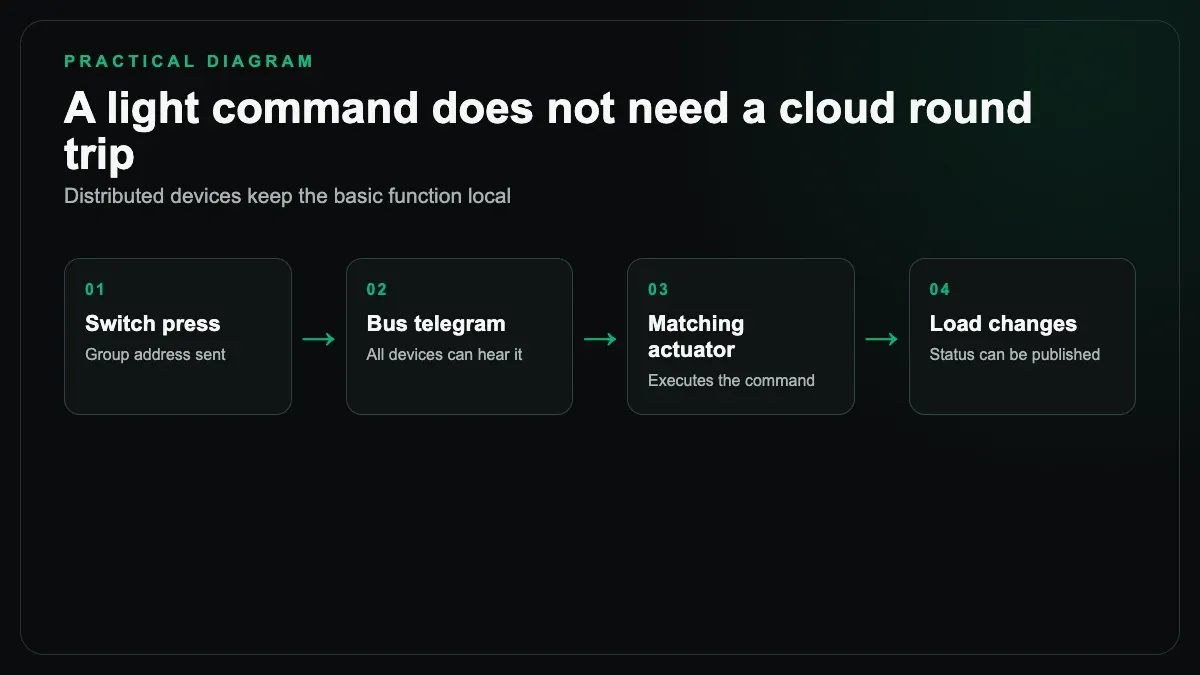
Lighting and blind control can operate on the bus without internet. The system does not need a consumer cloud for every button press. That reduces latency and removes one obvious external dependency.
The system can be distributed
KNX is not built around one consumer hub that must process every basic action. Devices communicate through group addresses, and functions can continue even if an optional visualisation server is offline. That does not mean nothing can fail. Power supplies, couplers, actuators, and wiring still need sensible design. It means the architecture need not place all control in one small box.
Product choice is broad
The standard allows keypads, sensors, actuators, and gateways from different manufacturers to coexist. This is valuable when the owner wants one brand's finish, another brand's actuator range, and a specialist HVAC interface.
Interoperability still requires engineering. A standard data type does not guarantee that every unusual feature maps perfectly between products. Select against the required function, not only the logo.
Large systems remain organised
A villa with many circuits, floors, and repeated room functions can benefit from KNX structure. Group addresses, panel schedules, and documented programming make expansion and troubleshooting manageable when the project file is maintained.
Physical controls can be excellent
KNX keypads can put scenes, dimming, blinds, and climate control into a clear wall interface. The best ones reduce the number of buttons while keeping common functions obvious. The worst ones turn a simple bedroom into a memory test. Interface design still matters.
Where KNX becomes expensive
Hardware is the visible part. The rest of the cost lives in wiring, panels, engineering, commissioning, and coordination.
A conventional electrical plan may switch loads at room boards. A centralised KNX plan may require each lighting circuit to return to an actuator panel. That affects cable quantities, panel size, containment, labour, and electrical drawings. Dimming adds compatibility work between actuators and LED drivers. HVAC integration may require manufacturer gateways. Premium keypads can cost far more than standard modular switches.
Programming is specialised work performed with ETS, the KNX engineering software. The integrator builds topology, individual addresses, group addresses, parameters, and device associations, then commissions and tests the installation.
Changes later are possible, which is one of KNX's strengths. They are not necessarily free. Ask how programming changes are charged and who keeps the latest project file.
For a framework to compare complete scopes rather than headline hardware prices, read our home automation cost guide for India.
Documentation decides whether "open" stays open
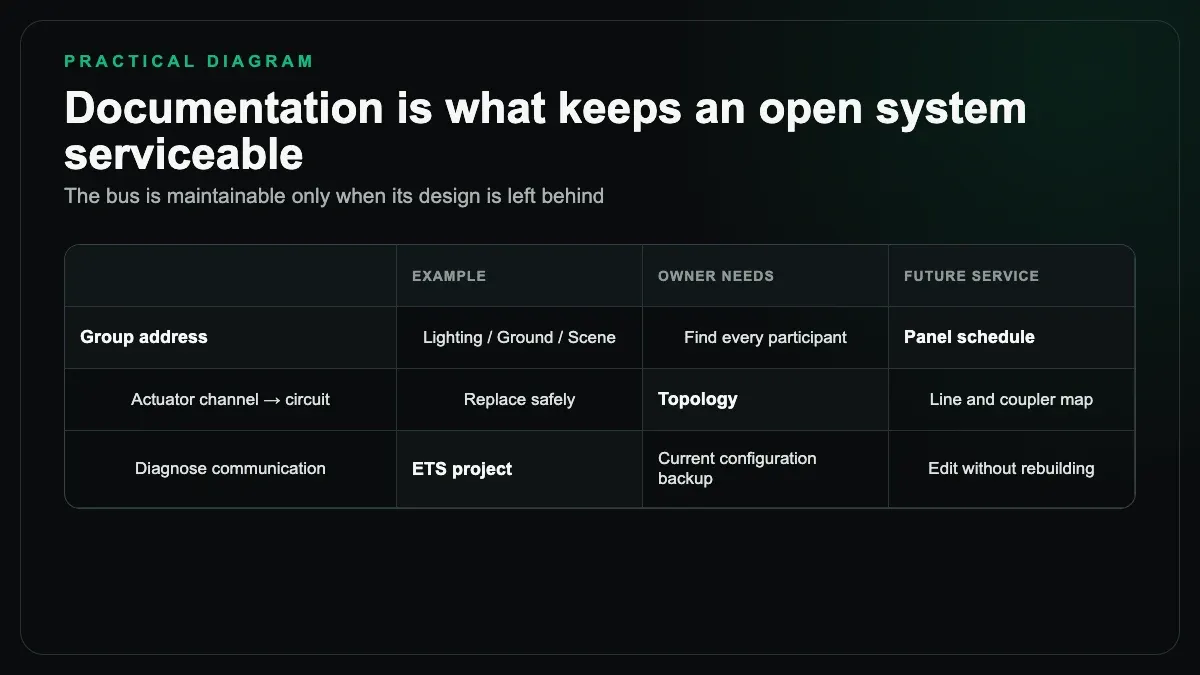
Vendor choice means little if the owner never receives the project records.
At handover, ask for:
- The current ETS project export
- Panel schedules and circuit labels
- Device list with model numbers
- Bus topology and power-supply details
- Group-address documentation
- Network settings for IP interfaces
- Administrator credentials for visualisation and remote access
- Backups of logic-controller configuration
- Warranty and support contacts
Keep copies outside the controller.
A new KNX professional can understand a documented project. Reverse engineering an unlabeled panel and missing ETS file is slower and more expensive. Openness is a property of the standard. Serviceability is a property of the handover.
Indian site conditions still apply
KNX avoids many radio problems for core functions, but it does not escape electrical reality.
Voltage fluctuation and poor earthing can damage power supplies, gateways, and connected equipment. Specify surge protection and coordinate backup power for the bus supply, controller, network, and security interfaces that need to remain active.
Panel location matters in Jaipur heat. Do not trap densely loaded actuators and network hardware in a decorative cupboard with no airflow. Keep access clear for testing and replacement. A panel behind a fixed wardrobe is not accessible because someone can technically dismantle the furniture.
Monsoon humidity matters in basements, gatehouses, service areas, and outdoor equipment enclosures. KNX bus wiring inside the home may be dependable while a poorly terminated gate interface fails every rainy season. The complete installation is only as strong as those edge connections.
Indian construction sequencing adds another risk. Electricians, ceiling teams, painters, and interior contractors may work from different drawings. Bus cable can be cut or mains can be applied to the wrong conductor if identification is poor. Supervision and testing at each stage are worth more than a polished app demo at the end.
KNX does not mean every device must be KNX
Hybrid design is often sensible.
Put core lighting, selected blinds, and important climate functions on KNX. Use IP for cameras and AV. Add Zigbee or another wireless protocol for movable sensors or secondary retrofit zones. Integrate these through a documented controller while keeping essential physical functions on the bus.
This can control cost and improve flexibility. It also introduces another platform that must be backed up and supported. The hybrid approach works when each layer has a clear job.
Our Wi-Fi, Zigbee, and Z-Wave comparison explains where those wireless layers fit.
When wireless is the better choice
Choose retrofit wireless when the home is finished and new bus wiring would mean destructive civil work. Choose it for a modest apartment where the required functions are simple and the local network can be made reliable. Choose it when the owner may move and wants a smaller investment in fixed infrastructure.
KNX is not automatically justified by a luxury property label. A homeowner who wants twelve lighting circuits, three ACs, and a door lock may not benefit from a large central panel and a full bus project. Conversely, a large new villa with dozens of dimming channels, blinds, HVAC zones, and complex scenes may become harder to maintain if built from scattered consumer modules.
For finished spaces, see our retrofit home automation guide.
Questions to ask a KNX integrator
Do not ask only which brands they sell. Ask how they work.
- Who designs the electrical topology and panel schedules?
- Which functions remain available if the visualisation server fails?
- How are lighting drivers tested with the selected dimmers?
- How is HVAC feedback obtained?
- What surge protection and backup power are included?
- Who owns the ETS project file?
- How are changes documented after handover?
- Can another qualified KNX integrator service the installation?
- What spare panel capacity and bus power are reserved?
- How will non-KNX systems such as cameras and AV be integrated?
The SmartR Spaces home automation team can review these questions against an actual Jaipur project before electrical work is frozen.
The verdict
KNX is worth considering when the home is under construction or major renovation, the function count is high, local operation matters, and the owner is willing to invest in design and documentation. It is especially strong for core building functions that should keep working regardless of an app or internet service.
It is a poor fit when walls are finished, the scope is small, or the project cannot support disciplined electrical coordination. In those cases, a good retrofit can be more sensible.
Do not buy KNX because it sounds professional. Buy a design in which the circuits, panels, bus, interfaces, failure modes, and handover are clear. The standard gives an integrator excellent tools. The drawings and commissioning determine what the homeowner actually gets.